
Home > Blog > Microdosing > The science behind magic mushrooms: how psilocybin shapes the mind
The science behind magic mushrooms: how psilocybin shapes the mind
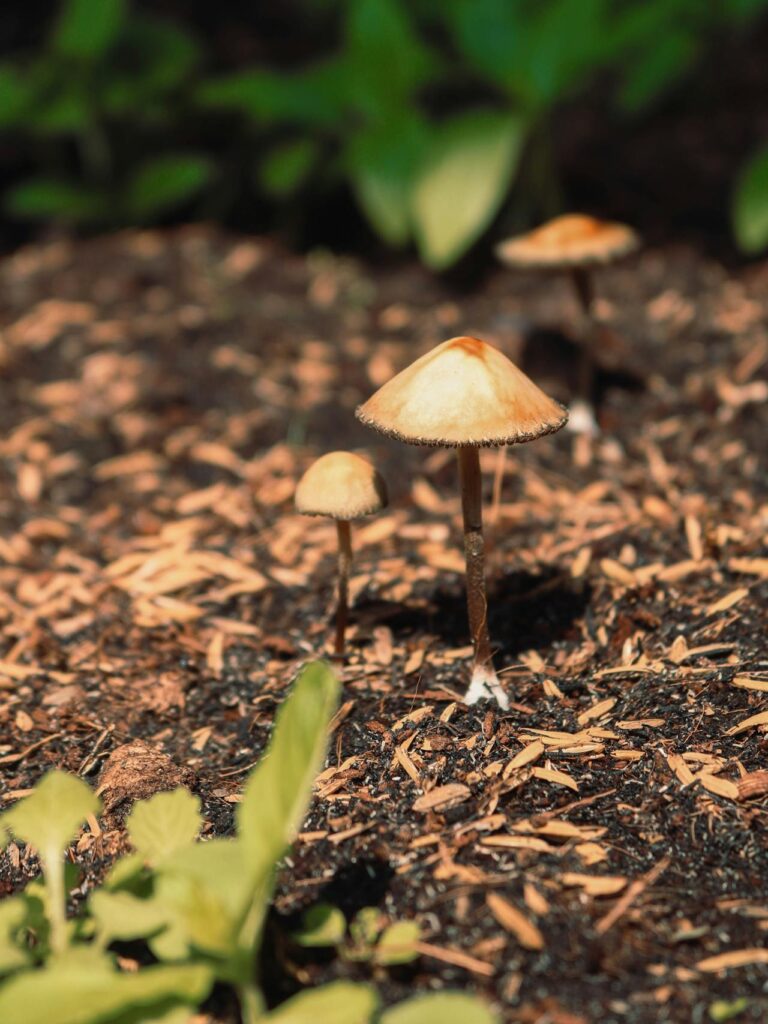
For as long as humans have explored consciousness, magic mushrooms have played a part in that journey. Today, modern science is catching up with what ancient cultures already sensed: these mushrooms change how we experience the world because they change how our brains communicate. At the center of it all is psilocybin, a natural compound that, once active, reshapes thought, emotion and perception for a short time.
The blog in 1 minute
Psilocybin, the natural compound in magic mushrooms, turns into psilocin in the body. It interacts with serotonin receptors and temporarily changes communication between brain regions, which can alter perception, emotion and awareness.
From ancient rituals to modern research
Centuries before laboratories and brain scans, psilocybin mushrooms were used in ceremonies by the Aztec and Mazatec peoples. They called them “teonanácatl”, which translates to “the flesh of the gods”. The Aztec and Mazatec used psilocybin to connect with something beyond the self. When Western scientists isolated psilocybin in the 1950s, interest in its potential grew quickly. What began as sacred practice evolved into scientific investigation: what exactly does this compound do in the human brain?
What psilocybin really does
Psilocybin itself is not the main actor. Once ingested, the body converts it into psilocin, a compound structurally similar to serotonin, one of the brain’s key messengers¹. This similarity allows psilocin to bind to serotonin receptors (especially 5-HT2A) but it does not act in exactly the same way. The interaction temporarily alters how information flows between brain regions, reducing the usual top-down control that keeps communication patterns stable². The result is a network that exchanges signals more freely and a mind that briefly perceives new connections and meanings.
What happens inside the brain
Under psilocybin, brain activity becomes less separated into strict regions. Areas that usually work on their own start to interact, forming new communication paths. fMRI scans show this clearly: patterns of activity become more fluid and less routine³. The default mode network (the part linked to our sense of self and daily narrative) quiets down. When that happens, many people report a sense of merging with their surroundings or losing the boundary between inner and outer experience⁴. It’s not imagination; it’s a measurable change in how the brain organizes reality.
Why perception and emotion change
Because psilocin acts on receptors involved in mood and sensory processing, the world can feel more vivid. Colors seem deeper, sounds feel physical, time slows down and emotions rise with unusual clarity. Researchers describe this as “increased entropy”: the brain’s filters relax, letting in more sensory data. What feels mystical is, in part, biology: a temporary release from our usual patterns of filtering and control.
The plastic brain
Recent studies suggest that psilocybin may support neuroplasticity (the brain’s ability to form new connections) according to early research⁵. This flexibility might help explain why participants in clinical trials often report shifts in mood and perspective that last beyond the immediate effects. In research at Imperial College London and Johns Hopkins University, psilocybin-assisted therapy appears to help people break repetitive thought patterns linked to depression and anxiety⁶. Scientists emphasize that this is not a cure; it shows that the brain, under the right conditions, can temporarily learn to rewire itself.
Risks and realities
Psilocybin is not addictive, and the body builds tolerance quickly. Still, it is not risk-free. For people with a personal or family history of psychosis or severe anxiety, the experience can be destabilizing. That’s why clinical studies always include psychological screening and professional guidance. Another misconception is that psilocybin permanently alters the brain. Current evidence shows its effects fade as the compound leaves the system. The mind may feel changed afterward, but that reflects perspective, not damage⁷.
New directions in psilocybin research
Interest in psilocybin has inspired broader exploration into natural and synthetic forms. Magic truffles contain psilocybin naturally and remain legal in certain countries, allowing researchers to study its effects in controlled settings. There’s also growing attention on mushroom drops: liquid formulations that make it easier to measure small doses in laboratory environments. Both natural and synthetic versions help scientists map how psilocybin affects the structure and communication of the brain.
What we still don’t know
Despite decades of study, many questions remain. Scientists are still discovering how changes in brain connectivity relate to lasting shifts in mood or outlook. Individual responses vary widely, and no one yet understands why. What is certain is that psilocybin gives us a rare scientific window into consciousness itself. Into how thoughts, emotions and perception combine to create reality, and how fragile that construction can be.
FAQ
Typically between four and six hours, depending on dose and metabolism.
Yes, both affect serotonin receptors, but psilocybin occurs naturally while LSD is synthetic and longer-lasting.
Some studies suggest temporary increases in empathy and openness, though results differ between individuals.
No, psilocybin is not considered addictive and does not produce physical dependence.
Current research shows that physical brain structure returns to baseline once psilocin leaves the system. Psychological insights, however, may linger.
Sources:
https://pubmed.ncbi.nlm.nih.gov/19650525/
https://www.nature.com/articles/npp201718
https://www.pnas.org/doi/10.1073/pnas.1119598109
https://www.pnas.org/doi/10.1073/pnas.1518377113
https://www.nature.com/articles/s41586-023-06204-3
https://www.nejm.org/doi/full/10.1056/NEJMoa2032994
https://www.frontiersin.org/articles/10.3389/fpsyt.2021.724606/full