
San Pedro: cómo afecta este cactus al cerebro
San Pedro is a cactus that grows in the Andes mountains in South America. Its scientific name is Echinopsis pachanoi.¹ People in this region have known and used this cactus for a very long time. Today, many people are also interested in San Pedro because of the natural substances inside the plant.
One of these substances can influence how the brain works. Because of this, the cactus is sometimes discussed in modern plant and brain research. You can also find information about San Pedro when people talk about natural sources of this substance.² The main substance in San Pedro is called mescaline.³
San Pedro as a natural source of mescaline
San Pedro naturally contains mescaline.³⁴ Mescaline is a substance that some plants produce on their own. Plants often create these substances to protect themselves in nature. In the San Pedro cactus, mescaline is the substance that researchers study the most.
The amount of mescaline in a cactus is not always the same. It can change depending on things like the age of the plant, the climate and the place where it grows. Mescaline is not the same as substances such as psilocybin. They belong to different chemical groups.² Scientists study these differences because they can affect how these substances work in the brain.
How mescaline interacts with the brain
The human brain uses many small chemical signals to send messages between brain cells. Mescaline can interact with one of the systems that helps control these signals. This system is connected to serotonin. Serotonin is a natural chemical in the brain that helps regulate mood, perception and thinking.⁵
When a substance such as mescaline interacts with this system, it can change how brain cells send messages to each other. Scientists study this process to better understand how the brain works. Most studies focus on the substance itself, not on the whole cactus.
Why scientists study mescaline
Mescaline belongs to a group of chemicals that can influence certain systems in the brain.² Because of this, researchers study it to learn more about brain communication. In many studies, scientists compare mescaline with other substances that affect the same brain system. These comparisons help them see what is similar and what is different.²
By studying these differences, researchers learn more about how the brain processes signals and information. This does not mean the research encourages uncontrolled use. It means researchers want to understand what happens under controlled conditions.
San Pedro compared with other mescaline cacti
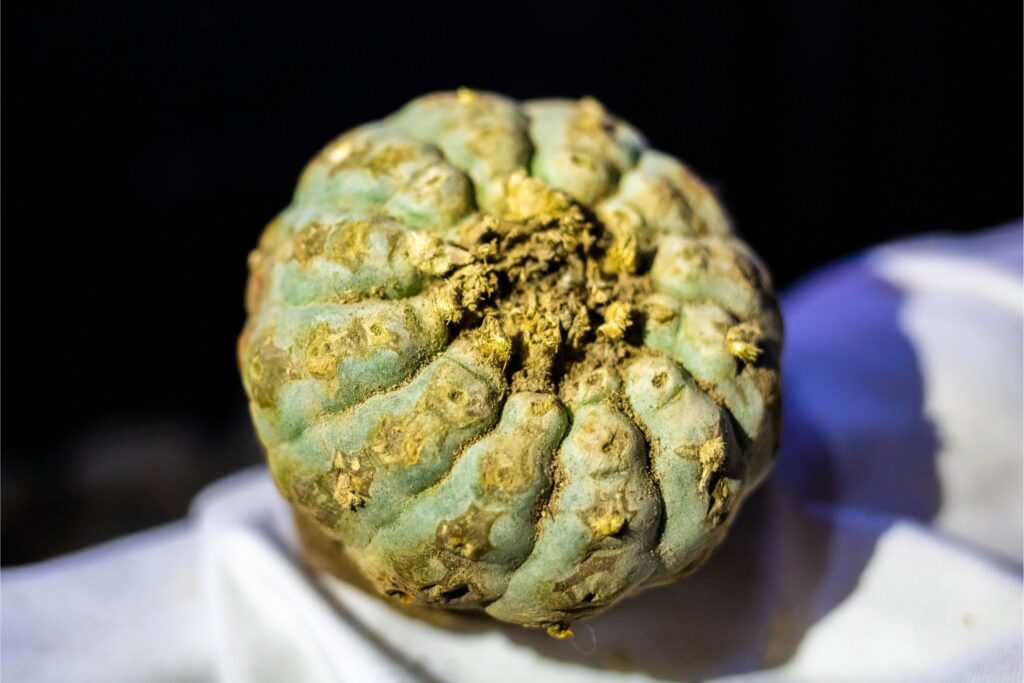
San Pedro is often compared with Peyote. Peyote is another cactus that also contains mescaline.¹ Even though both cacti contain the same substance, they look very different.
San Pedro grows tall and has long green columns with ribs. Peyote is small, round and grows close to the ground.¹⁸ These differences help scientists and botanists identify and classify different cactus species.
Legal differences between countries
The laws about mescaline and mescaline-containing plants are different in many countries.⁷ In some places, the chemical substance mescaline is regulated. The cactus itself may fall under different rules depending on how it is classified.
Because of these differences, discussions about San Pedro in science usually focus on the plant itself and its chemical structure.
Why San Pedro is still studied today
San Pedro is interesting to researchers because it connects traditional plant knowledge with modern science.² Scientists continue to study how the brain works and how natural substances interact with it. Plants such as San Pedro are sometimes part of this research.
By studying the cactus, its natural compounds and how they interact with the brain, researchers can learn more about plant chemistry and brain function.
FAQ
- What is the scientific name of San Pedro?
San Pedro is scientifically known as Echinopsis pachanoi. It is a cactus that grows in the Andes mountains of South America.¹ - Does San Pedro contain mescaline?
Yes. San Pedro naturally contains mescaline. The amount can vary depending on the cactus and where it grows.³⁴ - How does mescaline affect the brain?
Mescaline can interact with systems in the brain that are connected to serotonin. Scientists study this interaction to understand how brain signals work.²⁵ - Is San Pedro the same as Peyote?
No. They are different cactus species. Both can contain mescaline, but they look very different and grow in different ways.¹⁸ - Why do scientists study San Pedro?
Scientists study San Pedro because it contains mescaline. This substance helps researchers learn more about how certain brain systems work.²
2. https://doi.org/10.1124/pr.115.011478
3. https://pubchem.ncbi.nlm.nih.gov/compound/Mescaline
4. https://www.euda.europa.eu/publications/drug-profiles/mescaline_en
5. https://www.nature.com/articles/nrn2884
6. https://journals.plos.org/plosone/article?id=10.1371/journal.pone.0009019
7. https://www.euda.europa.eu/publications/drug-profiles/mescaline_en
8. https://powo.science.kew.org/taxon/urn:lsid:ipni.org:names:132175-2
